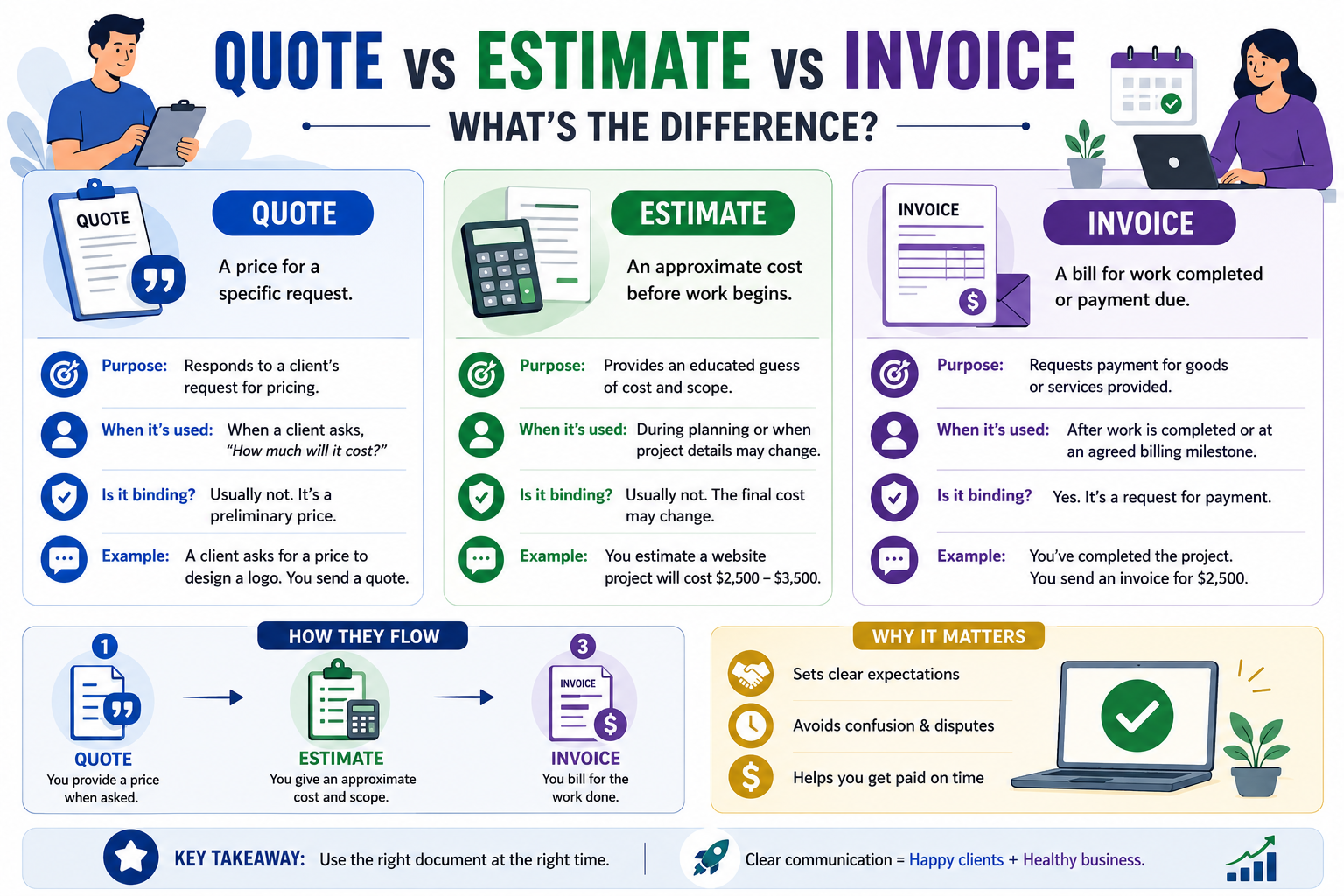
Many small business owners use the terms quote, estimate, and invoice interchangeably. That’s a mistake.
Although these documents may look similar, they serve very different purposes during the sales and billing process.
Sending the wrong document at the wrong time can cause:
- Client confusion
- Delayed approvals
- Payment disputes
- Accounting issues
- Cash flow problems
For example, sending an invoice before work is approved may damage trust. Sending an estimate when a client expects a fixed quote can lead to disagreements later.
Understanding the difference between quotes, estimates, invoices, and proforma invoices helps you communicate professionally and get paid faster.
In this guide, you’ll learn exactly what each document does, when to use it, and how they fit into the customer journey.
Need professional business documents? Create quotes, estimates, proforma invoices, and invoices using the free tools at iLove Invoice.
What Is the Difference Between a Quote, Estimate, and Invoice?
A quote provides a fixed price before work begins, an estimate provides an approximate cost that may change, and an invoice requests payment after products or services have been delivered. A proforma invoice is a preliminary invoice issued before final billing and is often used for approvals or international transactions.
What Is a Quote?
Definition
A quote (or quotation) is a document that provides a fixed price for products or services. When a quote is accepted, the business generally agrees to complete the work for the quoted amount.
Purpose of a Quote
Quotes help businesses:
- Present pricing
- Win projects
- Set expectations
- Reduce disputes
When to Use a Quote
Use a quote when:
- Pricing is predictable
- Scope is clearly defined
- Costs are unlikely to change
Advantages of Quotes
- Fixed pricing
- Clear expectations
- Professional presentation
- Easier approval process
Quote Example
Website Design Quote
| Service | Amount |
|---|---|
| Website Design | $2,500 |
| Contact Form Setup | $200 |
| Mobile Optimization | $300 |
| Total Quote | $3,000 |
If accepted, the client expects the final price to remain $3,000.
Key Characteristic
A quote is usually a fixed commitment.
What Is an Estimate?
Definition
An estimate provides an approximate cost for a project. Unlike a quote, the final amount may change.
Purpose of an Estimate
Estimates help businesses provide pricing before all project details are known.
When to Use an Estimate
Use estimates when:
- Project scope may change
- Material costs fluctuate
- Time requirements are uncertain
Advantages of Estimates
- Flexible pricing
- Useful for complex projects
- Easier to prepare early in the sales process
Estimate Example
Home Renovation Estimate
| Item | Estimated Cost |
|---|---|
| Labor | $4,000 |
| Materials | $3,500 |
| Permits | $500 |
| Estimated Total | $8,000 |
Actual costs may vary.
Key Characteristic
An estimate is an approximation, not a fixed promise.
What Is an Invoice?
Definition
An invoice is a payment request sent after products or services have been delivered.
Purpose of an Invoice
Invoices help businesses:
- Request payment
- Track revenue
- Maintain accounting records
- Document completed work
When to Use an Invoice
Send an invoice:
- After completing work
- After delivering products
- According to agreed milestones
- On recurring billing schedules
Advantages of Invoices
- Requests payment
- Creates financial records
- Supports tax reporting
- Tracks accounts receivable
Invoice Example
Marketing Agency Invoice
| Service | Amount |
|---|---|
| SEO Management | $1,500 |
| PPC Management | $1,000 |
| Total Due | $2,500 |
Payment Due: July 15, 2026
Key Characteristic
An invoice requests payment.
What Is a Proforma Invoice?
Definition
A proforma invoice is a preliminary invoice provided before final delivery or billing. It looks similar to an invoice but is not a payment demand.
Purpose of a Proforma Invoice
Businesses use proforma invoices to:
- Confirm pricing
- Obtain approvals
- Support customs documentation
- Clarify transaction details
When to Use a Proforma Invoice
Common situations include:
- International sales
- Custom orders
- Advance approvals
- Pre-shipment documentation
Advantages of Proforma Invoices
- Improves transparency
- Supports approvals
- Reduces misunderstandings
Proforma Invoice Example
Software Development Project
| Service | Amount |
|---|---|
| Development Phase 1 | $4,000 |
| Testing | $1,000 |
| Total | $5,000 |
This document is informational only. No payment is currently due.
Key Characteristic
A proforma invoice is not a final invoice.
Quote vs Estimate vs Invoice vs Proforma Invoice
Complete Comparison Table
| Feature | Quote | Estimate | Invoice | Proforma Invoice |
|---|---|---|---|---|
| Purpose | Offer Fixed Price | Provide Approximate Cost | Request Payment | Preliminary Billing Information |
| Timing | Before Work | Before Work | After Work | Before Final Invoice |
| Pricing Accuracy | Fixed | Approximate | Final | Expected |
| Requests Payment | No | No | Yes | Usually No |
| Customer Approval Needed | Yes | Usually | No | Often |
| Accounting Impact | None | None | Yes | Limited |
| Tax Impact | Usually None | Usually None | Yes | Varies |
| Legally Binding | Often After Acceptance | Usually Not | Payment Obligation | Generally Informational |
Business Workflow Explained
Most businesses follow a similar workflow.
Step 1: Lead
Potential customer makes an inquiry.
Step 2: Quote or Estimate
Business provides pricing information.
Step 3: Client Approval
Customer accepts the proposal.
Step 4: Proforma Invoice (Optional)
Used for approvals or international transactions.
Step 5: Products or Services Delivered
Work is completed.
Step 6: Invoice
Payment request is issued.
Step 7: Receipt
Payment is received and documented.
Simple Workflow Table
| Stage | Document |
|---|---|
| Inquiry | None |
| Pricing | Quote or Estimate |
| Approval | Signed Acceptance |
| Pre-Billing | Proforma Invoice |
| Payment Request | Invoice |
| Payment Confirmation | Receipt |
For more details: Invoice vs Receipt
Common Mistakes Businesses Make
Sending Invoices Too Early
Problem
Requesting payment before approval or delivery.
Solution
Use quotes or estimates first.
Confusing Quotes with Estimates
Problem
Clients believe pricing is fixed when it is not.
Solution
Clearly label documents.
Using Proforma Invoices Incorrectly
Problem
Treating proforma invoices as final invoices.
Solution
Issue a final invoice after work is completed.
Missing Payment Terms
Problem
Clients don’t know when payment is due.
Solution
Add clear payment terms.
Learn more: What Are Invoice Payment Terms
Poor Document Tracking
Problem
Businesses lose track of approvals and invoices.
Solution
Use invoice software with document management features.
Industry Examples
Freelancers
Scenario
A freelance writer receives a content project request.
Workflow: Estimate → Client Approval → Invoice
Consultants
Scenario
A consultant provides a fixed-fee advisory package.
Workflow: Quote → Approval → Invoice
Marketing Agencies
Scenario
An agency proposes monthly SEO services.
Workflow: Quote → Contract → Recurring Invoice
Contractors
Scenario
A remodeling contractor cannot predict material costs.
Workflow: Estimate → Project Completion → Invoice
Photographers
Scenario
A photographer offers fixed wedding packages.
Workflow: Quote → Deposit Invoice → Final Invoice
Web Designers
Scenario
A web designer charges fixed project fees.
Workflow: Quote → Deposit Invoice → Final Invoice
How Invoice Software Simplifies Document Management
Managing multiple document types manually can become difficult.
Modern invoicing software helps businesses:
- Create quotes
- Generate estimates
- Send invoices
- Track approvals
- Manage recurring billing
- Maintain records
Benefits of Automation
Faster Document Creation
Templates reduce repetitive work.
Better Organization
All documents remain in one system.
Improved Accuracy
Automation reduces manual errors.
Better Tracking
Businesses can track:
- Sent quotes
- Approved estimates
- Paid invoices
- Outstanding balances
Recommended Documents to Automate
| Document | Automation Benefit |
|---|---|
| Quotes | Faster proposals |
| Estimates | Better tracking |
| Invoices | Faster payments |
| Recurring Invoices | Automated billing |
| Receipts | Automatic confirmations |
Create professional documents using iLove Invoice.
Quick Decision Guide
Use a Quote If:
- Pricing is fixed
- Scope is clear
- You can commit to the price
Use an Estimate If:
- Costs may change
- Scope is uncertain
- Project complexity is high
Use a Proforma Invoice If:
- Approval is required
- International shipping is involved
- Preliminary billing details are needed
Use an Invoice If:
- Work is completed
- Products are delivered
- Payment is now due
Conclusion
Understanding the difference between quotes, estimates, invoices, and proforma invoices helps businesses communicate clearly, avoid billing mistakes, and improve cash flow.
Remember:
- Quotes provide fixed pricing.
- Estimates provide approximate pricing.
- Proforma invoices provide preliminary billing details.
- Invoices request payment.
- Receipts confirm payment.
Using the correct document at the correct stage creates a smoother customer experience and reduces misunderstandings.
Ready to simplify document management?
Create professional quotes, estimates, proforma invoices, and invoices using iLove Invoice.