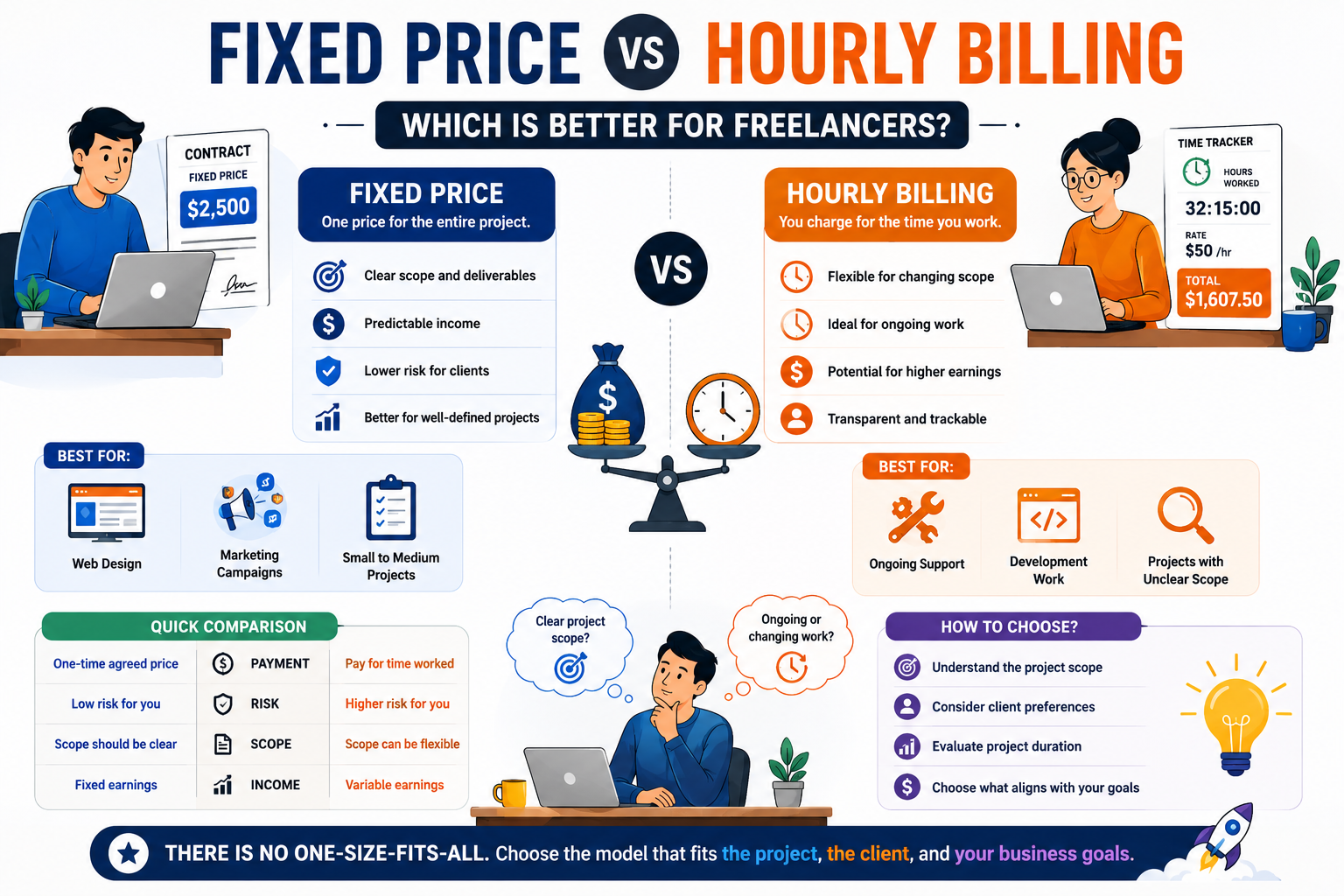
One of the biggest decisions freelancers make is how to charge clients.
Should you bill by the hour?
Or should you charge a fixed project fee?
The answer affects:
- Your income
- Your profitability
- Client relationships
- Project scope
- Cash flow
- Invoicing
Many freelancers undercharge because they choose the wrong pricing model. Others lose money because they fail to account for revisions, scope changes, or project complexity.
The good news is that both hourly billing and fixed-price pricing can work extremely well when used in the right situations.
This guide explains the differences, advantages, disadvantages, pricing formulas, and real-world use cases so you can choose the best pricing model for your freelance business.
Need professional invoices for hourly or project-based work?
Create invoices instantly using the free invoice generator at ilove-invoice.com
Should Freelancers Charge Hourly or Fixed Price?
Featured Snippet Answer
Freelancers should charge hourly when project scope is uncertain, ongoing, or difficult to estimate. Fixed-price billing works best when deliverables, timelines, and requirements are clearly defined. Many successful freelancers use both pricing models depending on the project type, risk level, and client expectations.
What Is Hourly Billing?
Hourly billing means charging clients based on the number of hours worked.
The client pays for time rather than deliverables.
How Hourly Billing Works
Simple formula:
Hours Worked × Hourly Rate = Invoice Amount
Example:
20 Hours × $75/hour = $1,500
Hourly Billing Examples
Designer
Logo revisions:
8 Hours × $60 = $480
Developer
Bug fixes:
15 Hours × $100 = $1,500
Consultant
Strategy sessions:
10 Hours × $150 = $1,500
Best Use Cases for Hourly Billing
Hourly pricing works best when:
- Project scope is unclear
- Work may change frequently
- Ongoing support is required
- Time requirements are unpredictable
- Client requests frequent revisions
What Is Fixed-Price Billing?
Fixed-price billing charges a predetermined amount for the entire project.
The price stays the same regardless of hours worked.
How Fixed Pricing Works
Simple formula:
Project Fee = Agreed Fixed Price
Example:
Website Design = $3,000
Even if the project takes 20 hours or 40 hours, the agreed price remains the same.
Fixed Price Examples
Website Design
Project Fee = $3,500
Brand Identity Package
Project Fee = $2,000
Content Package
10 Articles = $1,500
Best Use Cases for Fixed Pricing
Fixed pricing works best when:
- Scope is clearly defined
- Deliverables are predictable
- Timelines are established
- Experience allows accurate estimating
- Revision limits are included
Fixed Price vs Hourly Billing Complete Comparison Table
| Factor | Hourly Billing | Fixed Pricing |
|---|---|---|
| Profit Potential | Limited by time | Higher |
| Scalability | Lower | Higher |
| Predictability | Moderate | High |
| Client Preference | Mixed | Often Preferred |
| Scope Risk | Lower | Higher |
| Flexibility | High | Moderate |
| Revenue Ceiling | Limited | Less Limited |
| Payment Simplicity | Moderate | High |
| Efficiency Rewarded | No | Yes |
| Easier to Estimate | Yes | Requires Experience |
Quick Summary
Choose hourly billing when uncertainty is high.
Choose fixed pricing when scope is clearly defined.
Pros and Cons of Hourly Billing
Advantages
Lower Risk
If a project takes longer than expected, you’re still paid for your time.
Easier Pricing
New freelancers often find hourly rates easier to calculate.
Better for Ongoing Work
Retainers, consulting, and support work fit hourly billing well.
Scope Changes Are Easier
Additional work simply increases billable hours.
Disadvantages
Income Is Limited
You only earn when you’re working.
Efficiency Is Penalized
Working faster may reduce earnings.
Clients May Question Hours
Time tracking can create friction.
Difficult to Scale
Revenue is tied directly to available time.
Pros and Cons of Fixed-Price Billing
Advantages
Higher Income Potential
Efficient freelancers often earn more.
Easier Client Budgeting
Clients know the cost upfront.
Better Scalability
Revenue becomes tied to value rather than time.
Simpler Invoicing
Project pricing is easier for many clients to understand.
Disadvantages
Scope Creep Risk
Additional requests can destroy profitability.
Estimation Errors
Underestimating projects reduces earnings.
Requires Experience
Accurate project pricing takes practice.
More Upfront Planning
Project scope must be defined carefully.
When Freelancers Should Charge Hourly
Certain services naturally fit hourly pricing.
Designers
Charge hourly for:
- Revisions
- Design consultations
- Ongoing support
Developers
Charge hourly for:
- Maintenance
- Debugging
- Technical support
Consultants
Hourly pricing works well for:
- Advisory sessions
- Strategic consulting
- Coaching
Virtual Assistants
Most virtual assistants bill hourly because workload varies.
Coaches
Coaching sessions often follow hourly or session-based pricing.
When Freelancers Should Charge Fixed Price
Fixed pricing works best when deliverables are clearly defined.
Website Projects
Examples:
- Landing pages
- Small business websites
- Portfolio websites
Branding Projects
Examples:
- Logo design
- Brand guidelines
- Visual identity packages
Marketing Campaigns
Examples:
- Campaign setup
- Funnel creation
- Landing page design
Content Packages
Examples:
- 10 blog posts
- 20 social media posts
- Email sequences
SEO Audits
A defined deliverable with predictable scope.
Which Model Earns More?
For experienced freelancers:
Fixed pricing often generates higher profits.
Example:
Hourly Rate = $100
Expected Time = 30 Hours
Hourly Revenue:
30 × $100 = $3,000
If experience allows completion in 15 hours:
Hourly Billing:
15 × $100 = $1,500
Fixed Price:
$3,000
Same value delivered.
Double effective hourly earnings.
This is why many senior freelancers move toward fixed pricing.
How to Calculate Freelance Rates
Method 1: Income-Based Formula
Formula:
(Target Income + Expenses) ÷ Billable Hours
Example:
Target Income = $100,000
Business Expenses = $20,000
Billable Hours = 1,200
($100,000 + $20,000) ÷ 1,200
Hourly Rate = $100
Method 2: Project Pricing Formula
Formula:
Estimated Hours × Hourly Rate × Risk Factor
Example:
25 Hours × $100 = $2,500
Risk Factor = 20%
Final Quote = $3,000
Method 3: Value-Based Pricing
Instead of charging for time, charge based on value created.
Example:
Landing page generates $50,000 in sales.
Project Fee:
$5,000+
This pricing model often produces the highest profits.
Pricing Model Selection Checklist
Choose Hourly Billing If:
- Scope is unclear
- Revisions are frequent
- Ongoing support is required
- Time requirements are uncertain
- You’re new to freelancing
Choose Fixed Pricing If:
- Scope is clearly defined
- Deliverables are measurable
- Experience allows accurate estimates
- Efficiency is high
- Revisions are limited
How Pricing Affects Invoicing
Pricing directly impacts invoice structure.
Hourly Invoice Example
| Service | Hours | Rate | Total |
|---|---|---|---|
| SEO Consulting | 12 | $100 | $1,200 |
Fixed Price Invoice Example
| Service | Amount |
|---|---|
| Website Design Project | $3,500 |
Helpful Resources
Common Pricing Mistakes Freelancers Make
Charging Too Little
Problem:
Fear of losing clients.
Solution:
Price based on value and business costs.
Ignoring Scope Creep
Problem:
Additional work reduces profitability.
Solution:
Define project scope clearly.
Not Requesting Deposits
Problem:
Increased payment risk.
Solution:
Request 30–50% upfront.
Using One Pricing Model for Everything
Problem:
Poor fit for different project types.
Solution:
Use hourly and fixed pricing strategically.
Not Tracking Time
Problem:
Inaccurate pricing decisions.
Solution:
Track time even on fixed-price projects.
Failing to Increase Rates
Problem:
Income stagnates.
Solution:
Review pricing annually.
Real-World Pricing Examples
| Service | Hourly Model | Fixed Model |
|---|---|---|
| Logo Design | $75/hr | $800 |
| Website Design | $100/hr | $3,500 |
| SEO Audit | $125/hr | $1,500 |
| Blog Writing | $60/hr | $300/article |
| Marketing Strategy | $150/hr | $2,500 |
Conclusion
Both hourly billing and fixed-price billing can be effective.
The best choice depends on project scope, client expectations, and your experience level.
In general:
- Use hourly billing for uncertainty.
- Use fixed pricing for predictable deliverables.
- Use value-based pricing when results create significant business value.
Many successful freelancers use all three approaches depending on the project.
The goal isn’t choosing one pricing model forever.
The goal is choosing the right pricing model for the right project.
Ready to invoice clients professionally?
Create professional invoices for hourly or fixed-price projects using iLove Invoice.