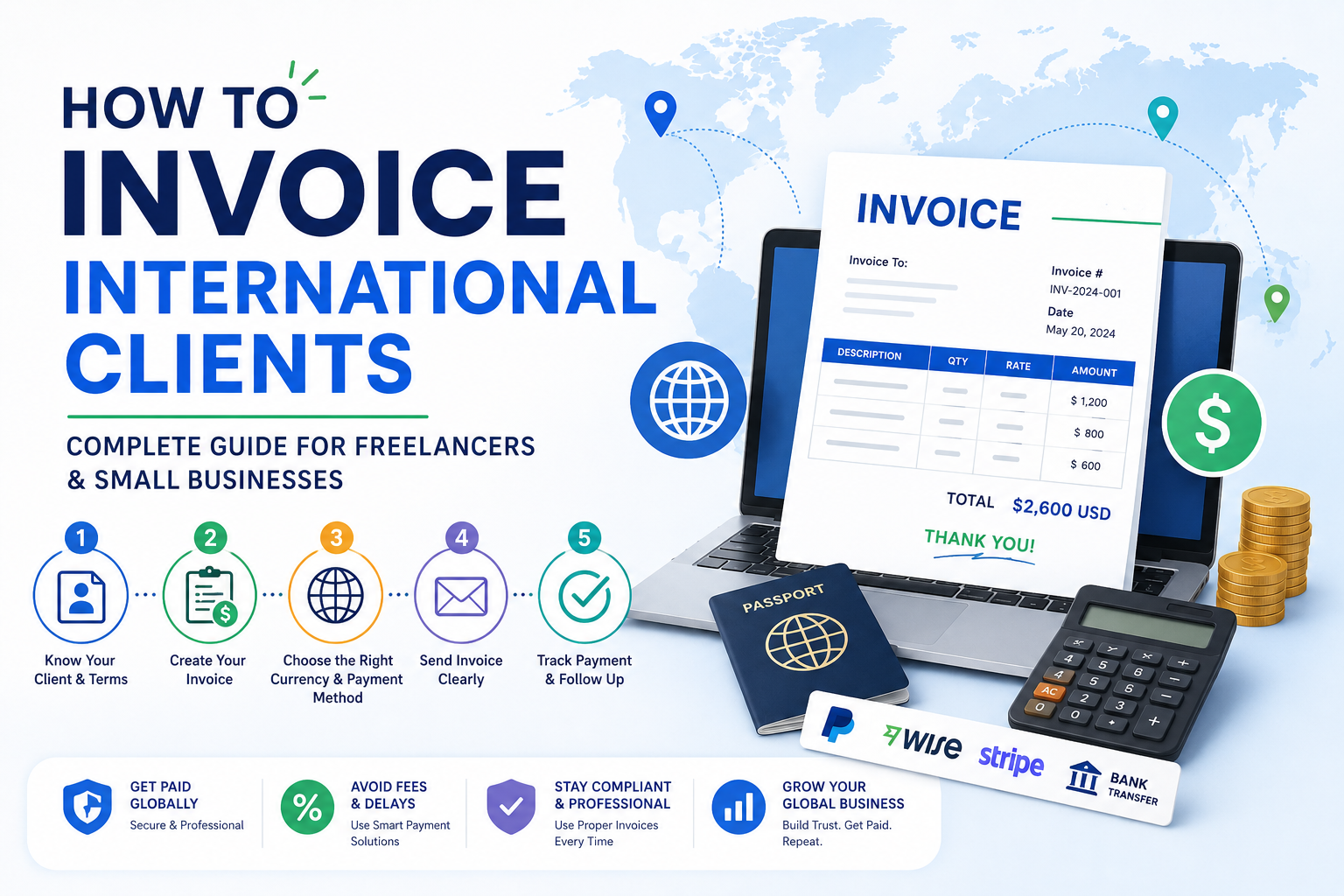
How to Invoice International Clients (Complete Guide)
Working with international clients can significantly expand your business opportunities, but getting paid across borders requires a slightly different invoicing process.
When invoicing overseas clients, you need to consider currency selection, international payment methods, tax requirements, payment terms, and banking details that are not typically required for domestic invoices.
This guide explains exactly how to invoice international clients, what information to include, which payment methods work best, and how to avoid costly mistakes.
Need to create a professional international invoice? Start with the free invoice generator at iLove Invoice.
Quick Answer: How Do You Invoice International Clients?
To invoice international clients:
- Collect the client’s billing information.
- Agree on the invoice currency.
- Create a professional invoice.
- Include any required tax information.
- Add international payment methods.
- Set clear payment terms.
- Send the invoice.
- Track payment status.
- Follow up if payment is overdue.
Your invoice should clearly show the currency, amount due, payment instructions, and due date to avoid delays.
What Is International Invoicing?
International invoicing is the process of billing a client located in another country for products or services provided.
Unlike domestic invoices, international invoices often include:
- Foreign currencies
- International payment methods
- Tax declarations
- Bank transfer information
- Cross-border compliance details
The goal is the same as any invoice: clearly communicate what the client owes, when payment is due, and how payment should be made.
What Should an International Invoice Include?
Every international business invoice should contain the following information.
International Invoice Checklist
Business Details
- Business name
- Business address
- Email address
- Phone number
- Tax ID (if applicable)
Client Details
- Client name
- Company name
- Billing address
- Contact email
Invoice Information
- Invoice number
- Invoice date
- Due date
Services or Products
- Description
- Quantity
- Rate
- Subtotal
Currency
- USD
- EUR
- GBP
- CAD
- AUD
- (or another agreed currency)
Taxes
- VAT
- GST
- Sales tax (if applicable)
Payment Information
- Bank details
- IBAN
- SWIFT/BIC
- Wise
- PayPal
- Payoneer
Final Amount
- Total amount due
- Currency clearly displayed
International Invoice Requirements Table
| Field | Required |
|---|---|
| Business Name | Yes |
| Client Information | Yes |
| Invoice Number | Yes |
| Invoice Date | Yes |
| Due Date | Yes |
| Currency | Yes |
| Service Description | Yes |
| Total Amount Due | Yes |
| Tax Information | If Applicable |
| Payment Instructions | Yes |
| Bank Details | Recommended |
How to Invoice International Clients Step-by-Step
Step 1: Collect Client Information
Before creating the invoice, collect:
- Client name
- Company name
- Billing address
- Accounts payable email
- Tax information
- Preferred payment method
Confirm all details before sending the invoice. Incorrect information can delay payment.
Step 2: Choose the Correct Currency
One of the first decisions is choosing the invoice currency.
The most common currencies are:
- USD (US Dollar)
- EUR (Euro)
- GBP (British Pound)
- CAD (Canadian Dollar)
- AUD (Australian Dollar)
Generally:
- Invoice in the client’s currency if they request it.
- Invoice in your local currency if agreed beforehand.
- Clearly state the currency on every invoice.
For example:
Total Due: USD $2,500
Never assume the client knows which currency you’re using.
Step 3: Create a Professional Invoice
Your invoice should include:
- Unique invoice number
- Client details
- Service descriptions
- Quantity
- Rates
- Total amount due
- Currency
- Payment instructions
Step 4: Add Tax Information
Tax requirements depend on:
- Your country
- The client’s country
- Type of service
- Business structure
Common tax-related items include:
- VAT
- GST
- Reverse charge statements
- Tax registration numbers
When in doubt, consult a qualified tax professional.
Step 5: Add International Payment Methods
The easier it is to pay, the faster you’ll get paid.
Provide multiple payment options whenever possible.
Examples:
- Wise
- PayPal
- Payoneer
- Stripe
- Bank Transfer
Step 6: Set Payment Terms
Common international invoice payment terms:
| Payment Term | Meaning |
|---|---|
| Due Upon Receipt | Immediate payment |
| Net 7 | Due within 7 days |
| Net 15 | Due within 15 days |
| Net 30 | Due within 30 days |
For most freelancers and agencies, Net 15 provides a good balance between flexibility and cash flow.
Step 7: Send the Invoice
Most international invoices are sent via:
- Client portal
- Invoicing software
PDF is the preferred format because it maintains consistent formatting.
Step 8: Track Payment Status
After sending:
- Confirm receipt
- Monitor due dates
- Record payments
- Update accounting records
Invoice tracking prevents overdue invoices from being forgotten.
Step 9: Follow Up Professionally
If payment is late:
- Send a reminder before the due date.
- Follow up on the due date.
- Follow up again after 7 days.
- Escalate politely if necessary.
Many international payments are delayed simply because the invoice was overlooked.
Best Currencies for International Invoices
| Currency | Advantages | Disadvantages | Best For |
|---|---|---|---|
| USD | Most widely accepted | Exchange rate risk | Global clients |
| EUR | Common across Europe | Exchange fluctuations | EU clients |
| GBP | Preferred in UK | Exchange fluctuations | UK clients |
| CAD | Familiar to Canadian clients | Less global acceptance | Canada |
| AUD | Preferred by Australian businesses | Limited international use | Australia |
Expert Tip: If most of your clients are international, consider using USD as your default invoicing currency because it is widely accepted and easy to process through global payment platforms.
Best International Payment Methods Compared
| Method | Fees | Speed | Availability | Pros | Cons |
|---|---|---|---|---|---|
| Wise | Low | 1-2 Days | Global | Excellent exchange rates | Limited card options |
| PayPal | Medium-High | Instant | Global | Easy to use | Higher fees |
| Payoneer | Medium | 1-3 Days | Global | Popular with freelancers | Withdrawal fees |
| Stripe | Medium | 2-7 Days | Many Countries | Professional checkout | Not available everywhere |
| Bank Transfer | Varies | 1-5 Days | Global | Direct payment | Can be expensive |
| ACH | Low | 1-3 Days | Primarily US | Low cost | Limited internationally |
Recommended Setup
For most freelancers:
- Wise
- PayPal
- Bank Transfer
This combination covers most international clients.
International Invoice Example
| Invoice Field | Example |
|---|---|
| Invoice Number | INV-2026-1001 |
| Invoice Date | July 1, 2026 |
| Due Date | July 15, 2026 |
| Client | ABC Marketing Ltd |
| Country | United Kingdom |
| Service | SEO Consulting |
| Quantity | 10 Hours |
| Rate | USD $100 |
| Subtotal | USD $1,000 |
| Tax | USD $0 |
| Total Due | USD $1,000 |
| Payment Method | Wise or Bank Transfer |
International Taxes Explained
Tax rules vary significantly by country. Always consult a qualified accountant or tax advisor for specific advice.
VAT
VAT (Value Added Tax) is commonly used in Europe and many other countries. Depending on the transaction, VAT may need to be charged or reported.
GST
GST (Goods and Services Tax) is commonly used in countries such as:
- Australia
- Canada
- New Zealand
GST requirements vary by jurisdiction.
Sales Tax
Sales tax applies mainly in the United States. Whether sales tax applies depends on:
- State regulations
- Product type
- Service type
Reverse Charge Mechanism
Many B2B international transactions use a reverse charge mechanism. Under this arrangement, the customer accounts for VAT instead of the supplier.
W-8BEN
A W-8BEN is commonly requested from non-US freelancers and businesses working with US companies. It helps establish foreign tax status.
W-9
US-based contractors often provide a W-9 form to clients for tax reporting purposes.
1099
US businesses may issue Form 1099 to qualifying independent contractors. Understanding these forms helps avoid payment and compliance issues.
Common International Invoicing Mistakes
| Mistake | Why It Happens | How to Avoid It |
|---|---|---|
| Missing currency | Assumptions | Clearly display currency |
| Incorrect client details | Data entry errors | Verify information |
| Missing invoice number | Poor tracking | Use sequential numbering |
| Vague service descriptions | Lack of detail | Be specific |
| Missing payment methods | Oversight | Include multiple options |
| No payment terms | Inexperience | Add due dates |
| Ignoring tax requirements | Lack of research | Consult professionals |
| Incorrect totals | Calculation errors | Double-check invoices |
| Sending invoices late | Poor workflow | Invoice immediately |
| Not following up | Fear of asking | Use reminder schedule |
How to Get Paid Faster by International Clients
Request Deposits
For larger projects, request:
- 30% upfront
- 50% upfront
This reduces risk.
Use Milestone Billing
Break large projects into payment milestones. This improves cash flow and reduces outstanding balances.
Offer Multiple Payment Methods
Give clients flexibility. The fewer barriers to payment, the faster payment arrives.
Use Net 15 Terms
Shorter payment terms generally result in faster payments.
Send Automated Reminders
Many overdue invoices are paid immediately after a reminder.
Offer Early Payment Incentives
Example: “2% discount if paid within 5 days.”
This can encourage faster payment.
Country-Specific Invoicing Tips
US Clients
- USD is preferred.
- ACH is widely used.
- W-8BEN may be required for non-US freelancers.
- Larger companies often use accounts payable departments.
UK Clients
- GBP is generally preferred.
- Include VAT information if applicable.
- Bank transfers are common.
European Clients
- EUR is typically preferred.
- VAT considerations are important.
- Reverse charge rules may apply.
Canadian Clients
- CAD is preferred by many businesses.
- GST/HST requirements may apply.
Australian Clients
- AUD is commonly preferred.
- GST requirements may apply depending on the transaction.
Conclusion
International invoicing doesn’t need to be complicated.
If you collect the right client information, choose the correct currency, include clear payment instructions, and use reliable payment methods, you’ll significantly reduce payment delays and improve cash flow.
Remember the essentials:
- Use a professional invoice.
- Clearly state the currency.
- Include tax information when required.
- Offer multiple payment methods.
- Set clear payment terms.
- Follow up on overdue invoices.
Whether you’re a freelancer, consultant, agency owner, developer, designer, or small business, a structured invoicing process will help you get paid faster and operate more professionally across borders.
Ready to create professional international invoices?
Create, customize, and send invoices in minutes using the free invoice generator at iLove Invoice.